WHAT SHIPS TODAY
Every capability on this page ships today, with a measured answer behind it — a memory with rules, sweeps that compound, and a door any MCP-capable agent can open.
DEEP FIX
The daily cycle asks what work arrived. A sweep asks the other half: what is wrong with what we already built, and does it keep being wrong the same way? Auditors run in waves, and every wave inherits the finding types the waves before it discovered — so the rubric is a permanent asset of the product, not a linter's fixed opinion.
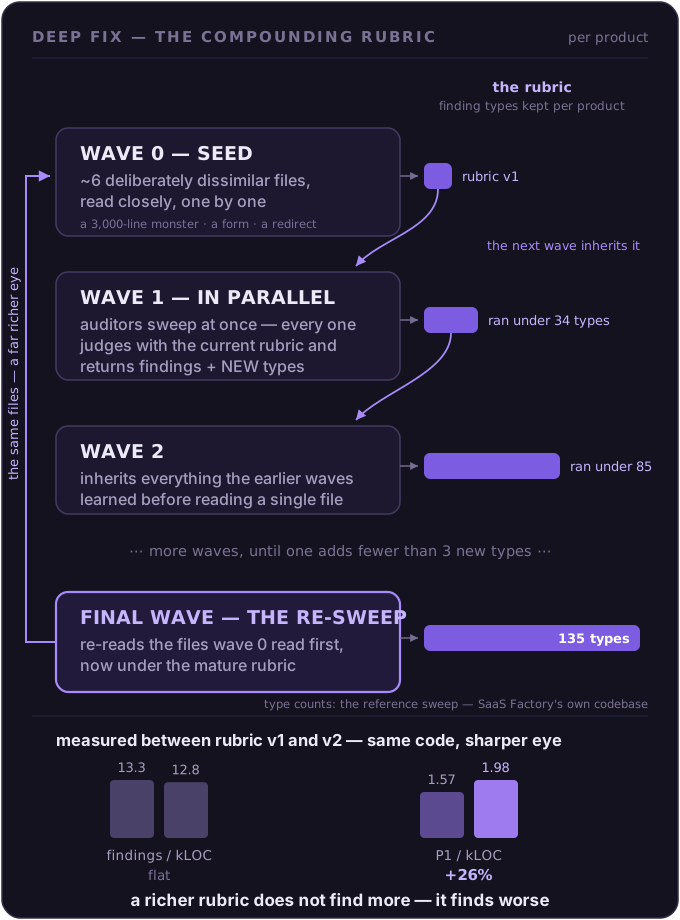
Findings close as fixed, refuted on inspection, owner decision, or upstream — a fixer who correctly rejects a finding is a first-class outcome, not a failure.
ONE MEMORY PER TEAM
A workspace binds to a repository with a committed file, so every member's agent — on any machine — opens the same memory. Teammates who only need to see don't need a member seat.
Viewer seats, server-enforced Read-only, enforced on the server rather than hidden in the UI — ten viewer seats per workspace by default, adjustable per workspace.
Share a board by link A daily run can be shared read-only with someone outside the org entirely — no account required. Links expire, revoke without breaking a live run, and every view is recorded.
Machines on record Every machine that ever synced is on record — a wiped laptop's history is never erased, just joined by its successor.
MEMORY WITH A BUDGET
A memory system fails by flooding. SF Recall refuses the flood: corrections supersede rather than stack, and standing decisions draw from a hard budget, so importance keeps meaning something.
Supersede, never stack A near-duplicate deposit is refused with the existing answer attached — you replace it or you drop yours.
A standing-decision budget When the budget is full, something must be demoted before anything new is promoted. No infinite pile of 'critical'.
Attention items are promises Unfinished business reappears at every standup until someone closes it — it cannot quietly rot in a backlog.
Provenance on every memory Each memory points back to the session that wrote it, so 'why do we do it this way?' has a checkable answer.
YOUR AGENT, YOUR TOOLS
The memory mounts over MCP with OAuth — if your tool speaks MCP, it can open a standup and deposit. Claude Code is the reference adapter for transcript capture, and other tools plug in through the same adapter interface. Work sources are recipes — which MCP tool to call, and what counts as a signal — so a new integration is configuration, not a vendor SDK and an OAuth dance.